


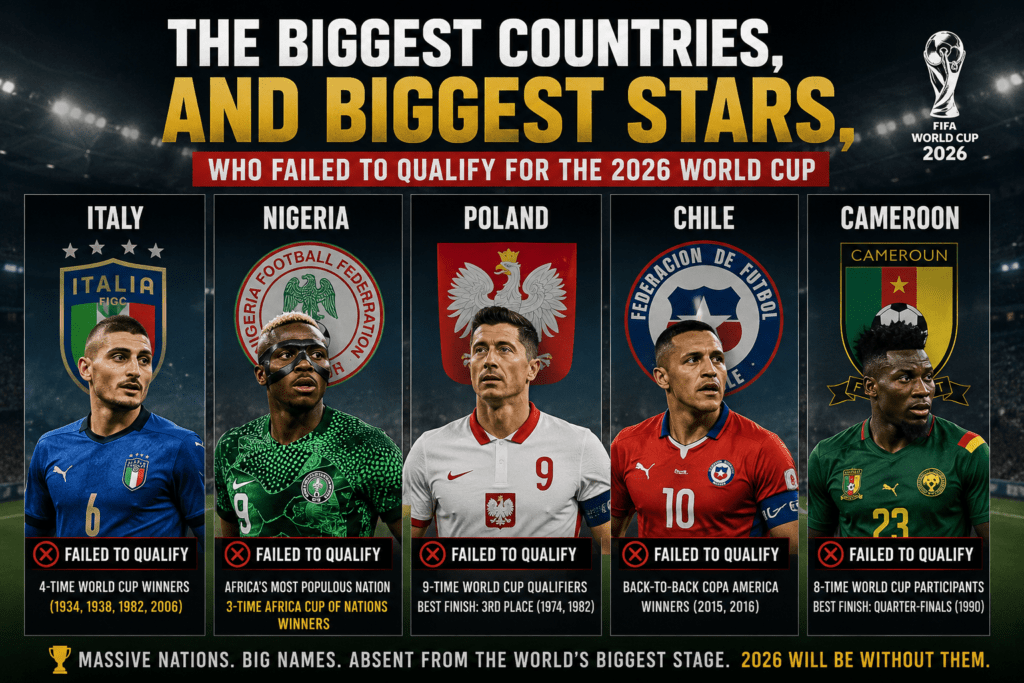
The 2026 FIFA World Cup is set to be the biggest edition in the tournament’s history, featuring 48 nations and being hosted across the United States, Mexico and Canada.
The expanded format has given more countries than ever before the opportunity to compete on football’s biggest stage. Yet, despite the additional places, several traditional football powers failed to secure qualification, leaving millions of supporters disappointed.
Among the notable absentees are former world champions, African heavyweights and nations that have produced some of the game’s biggest stars. Here is a look at the major countries that will miss the 2026 World Cup and what their absence means.
Italy: A Stunning Third Consecutive Failure
Few stories in international football are as shocking as Italy’s continued absence from the World Cup.
The four-time world champions won the tournament in 2006 and have long been regarded as one of football’s elite nations. However, the Azzurri have now missed three consecutive World Cups, extending one of the most surprising downturns in modern football history.
Italy struggled to find consistency throughout qualifying and ultimately failed to book their place in North America. The absence of stars such as goalkeeper Gianluigi Donnarumma and midfielder Sandro Tonali deprives the tournament of some of Europe’s finest talents.
For a nation with such a rich football tradition, another missed World Cup raises serious questions about the long-term direction of Italian football and the effectiveness of its player development system.
Nigeria: Super Eagles Suffer Another Heartbreaking Exit
Nigeria’s failure to qualify is one of the biggest disappointments for African football.
The Super Eagles have traditionally been among Africa’s most successful World Cup nations, reaching six editions of the tournament and producing memorable moments on the global stage. However, their hopes of qualifying for the 2026 tournament ended in painful fashion.
The absence of Nigeria means fans will not get to watch some of Africa’s brightest stars, including prolific striker Victor Osimhen and reigning African Footballer of the Year Ademola Lookman.
Nigeria’s failure to reach the tournament is particularly disappointing because of the quality available within the squad. Many supporters expected this generation of players to challenge the world’s best teams on football’s biggest stage.
Despite the disappointment, Nigerian fans are expected to follow the tournament closely, especially with several African nations representing the continent in North America.
Poland: A Painful End for the Lewandowski Generation
Poland’s failure to qualify could mark the end of an era.
For over a decade, Robert Lewandowski has been the face of Polish football, becoming one of the greatest strikers of his generation and the country’s all-time leading scorer. However, Poland’s qualification campaign ended in heartbreak, denying the veteran forward what may have been his final opportunity to appear at a World Cup.
The country’s golden generation has delivered memorable moments over the years, but failing to qualify for the 2026 tournament highlights the need for renewal and the emergence of younger talent.
As Lewandowski approaches the final years of his career, Poland now faces the difficult task of rebuilding for the future.
Chile: From Continental Champions to World Cup Outsiders
A decade ago, Chile were one of South America’s most feared teams.
Back-to-back Copa América triumphs in 2015 and 2016 established La Roja as a major force on the continent. Led by stars such as Alexis Sánchez and Arturo Vidal, Chile consistently competed against the best teams in world football.
Today, the picture looks very different.
Chile endured another disappointing qualification campaign and will once again miss the World Cup. Their struggles reflect the challenges of transitioning from a golden generation to a new era, with younger players yet to fully replace the country’s former stars.
By the time the next World Cup arrives, Chile’s absence from the tournament will have stretched to 16 years, a remarkable statistic for a nation that was once among South America’s elite.
Cameroon: African Giants Left Watching From Home
Cameroon have long been one of Africa’s most iconic football nations.
The Indomitable Lions became the first African team to reach a World Cup quarter-final in 1990 and have inspired generations of footballers across the continent. However, they will not be present at the 2026 tournament.
Cameroon’s absence underlines the increasing competitiveness of African football. With more countries investing in youth development and infrastructure, traditional powerhouses can no longer take qualification for granted.
Although the current squad still possesses quality and experience, missing the World Cup will undoubtedly be viewed as a major setback for one of Africa’s most celebrated football nations.
A World Cup Missing Some Familiar Faces
The expansion to 48 teams was expected to give more established football nations a second chance at reaching the tournament. Instead, several giants have still been left behind.
Italy’s continued decline, Nigeria’s heartbreak, Poland’s transition, Chile’s prolonged struggles and Cameroon’s disappointment all serve as reminders of how difficult World Cup qualification has become.
While the 2026 FIFA World Cup promises to deliver unforgettable moments, it will do so without some of football’s most recognisable nations and biggest stars.
